
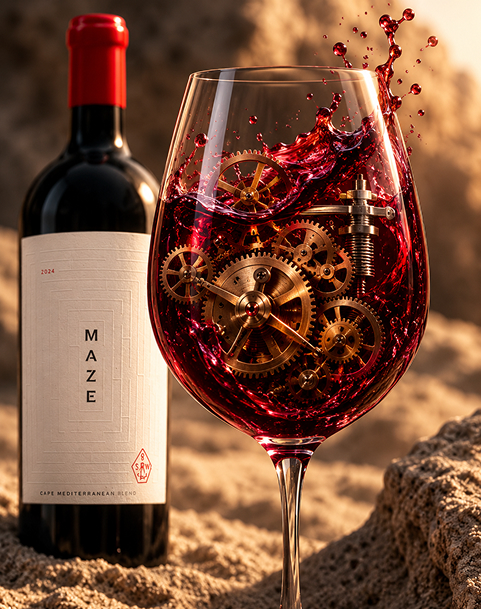
So, how do we think? And how did we get to make the Maze Cape-Med blend?
Winemakers are complex creatures. We are a bit like a Newton’s Cradle, where every action has a reaction, but the reaction is reversed from left to right — or rather, forwards and backwards.
We think like that when we make wine.
We plan something, think about it, predict the outcome and then go back and adjust. We tweak, taste, reconsider and adjust again, trying to get the perfect reaction. And we do this throughout the year, year upon year, always working in a cycle and continuously adjusting, while somehow trying to keep the final outcome the same.
It sounds complicated.
It is.
And we love it.
Winemakers are their own worst critics. We are constantly tasting wines with a negative, “seek the fault” approach. We are taught to overthink the wine in front of us. We seek out the faults, the weaknesses, the things that could be better.
Then we adjust our winemaking techniques to achieve the perfect wine quality and style outcome.
We blend to achieve perfection.
Have you ever been in a tasting with a bunch of winemakers?
It is crazy!
They — we — will always find the fault in the wine and then tell you what we would have done differently. It is almost impossible for a winemaker to simply drink a wine and say, “This is delicious.”
There is always a “but…”
Petre and I studied together at Elsenburg Agricultural College, where we completed the postgraduate course in Oenology in 2005.
Petre was probably the best taster in our group when it came to identifying faults in wine, identifying cultivars or even working out which region a wine came from. I was not too bad either, but there were always approximately four or five winemaking students ahead of me.
I only found my “niche” in winemaking many years later, when I realised that I could blend extremely well.
Petre and I are friends, and I am so glad that we are different winemakers and that we focus on our individual strengths.
When we look at the individual components of wines, I rely 100% on Petre’s taste profile to identify the individual components of the Maze blend.
Petre, on the other hand, is quite happy that I take the lead when it comes to putting them all together.
But, like the Newton’s Cradle, making up the blend is a one-step-forward, one-step-backward day of blending.
It takes many blending attempts to get the perfect ratio between the cultivars. And then comes the next question:
Which barrel makes the cut?
And which barrel does not?
We were asked to make a Cape Mediterranean blend. All the information is on our website, but let me take you through the thought process of two winemakers and how we got to our first Maze vintage.
The First Cogs Start Turning
We wanted a classic red blend, which is usually Cabernet Sauvignon-based, but we wanted to create something slightly different.
We wanted more red fruit. A lighter-styled approach. Something fresher, but still serious.
The question given to us was:
How do you make a Cabernet Sauvignon blend more “red fruit”, with more “finesse and velvety” character?
The answer was relatively easy.
Cabernet Sauvignon blends are usually associated with Bordeaux’s Left Bank, where Cabernet Sauvignon dominates and the wines are generally associated with darker, black-fruit profiles.
On the Right Bank of Bordeaux, for example Saint-Émilion, Cabernet Franc and Merlot play a much more prominent role, with Cabernet Franc bringing more red fruit and, in our experience, a more velvety tannin profile.
I made wine at Château Angélus in 2000 and 2001, so this way of thinking was already sitting somewhere in the back of my winemaking brain.
One of the cogs clicked into place.
Cabernet Franc had to be one of the base wines.
The next question was slightly different.
We wanted the seriousness and structure of a bold red wine blend, but we also wanted spice and silky tannins.
I have been making wine in the Swartland wine region for some time, and one thing that has consistently stood out to me over the vintages is the high pH of some of the grapes and wines.
This is influenced by the unique ancient shale, schist and granite soils around Malmesbury and Riebeek Kasteel.
We actively seek out higher-pH Shiraz parcels and wines because we believe these higher-pH wines can give you extremely silky tannins.
Another cog started turning.
We knew that Grenache Noir and Cinsaut would give us the red fruit we were looking for.
These varieties naturally have larger grape berries, which can result in a lighter-coloured red wine. That was perfect for the Cape Mediterranean style we were trying to create, while also giving us a nod towards the increasingly interesting Southern Rhône and Italian red blends.
So far, so good.
But we were still missing something.
The Magic Potion
We made up the blends, but we were still looking for two things.
One was a very specific sweet, candy-floss/cherry fruit character.
Just from experience — but also, if I am honest, partly by chance — I immediately told Petre that we needed some carbonically macerated wine in the blend.
We managed to get hold of a Petite Sirah that had undergone carbonic maceration.
We added a very small amount to the bigger blend.
And suddenly…
Boom.
The wine transformed.
That tiny addition brought a floral, candy-floss-laced character into the blend.
We knew we were on the right track.
It was like adding a few drops of magic potion from Getafix in Asterix and Obelix.
Sometimes winemaking is science.
Sometimes it is experience.
And sometimes, thankfully, it is a little bit of magic.
We had our five varieties and made up two blends. We presented them to the Motley Crew.
We knew we had two great wines and that this would give us the perfect direction.
The feedback was great.
But then came the question.
Actually, a few questions.
“What makes this blend different?”
“What is the unique selling point of the wine?”
“What brings all these cultivars together?”
“What holds them together?”
These were strategic questions.
And it took many bottles of great wine, some great steaks and a few espressos to go back to the drawing board.
We asked ourselves:
What would work in our blend?
What would complement the blend?
And, most importantly, what could hold its own without overpowering everything else?
The Sixth Cog
We narrowed it down to three possibilities:
Touriga Nacional.
Viognier.
Carignan.
Touriga Nacional made the blend very venison-like and took away too much of the fruit.
Viognier was simply too floral and started overpowering the red-fruit character we had worked so hard to achieve.
Then came Carignan.
And Carignan was perfect.
It was subtle, yet firm.
It enhanced the blend and lifted it into something unique without shouting for attention.
And that, for me, is exactly what a blending component should do.
It should not necessarily announce itself.
It should make everything around it better.
Was it the cultivar?
Was it the terroir?
Was it the age of the vines?
Or was it because the vines were bush vines?
Time will tell.
I would like to believe it is all of the above.
So ask me that question again in a couple of years.
Maybe by then we will have another cog to add to the machine.
The First Maze
The 2024 Maze blend was made from individual components, and the first Maze blend was ultimately created from the dream of five founding members and the Motley Crew.
Like the Newton’s Cradle, the next vintage would follow the same one-step-forward, one-step-backward approach.
And it would be even more challenging to stay within the narrow lanes of our new Cape Mediterranean-styled blend.
The 2025 and 2026 Maze components have now been made, and I am happy to say that we followed the same process.
It was nerve-racking in the beginning because you never really know whether another vintage will allow you to follow the same blending rules that worked in 2024.
Every vintage has its own personality.
Every parcel behaves differently.
Every barrel has something to say.
But the role of each cultivar was played individually, just as we had planned.
We also enhanced and honed in on additional winemaking techniques that would give us a bigger scope and more possibilities from the six cultivars.
I will leave the 2025 and 2026 winemaking story for another blog, but we were pleasantly surprised that our planning for each cultivar worked out so well.
In fact, the 2025 blend is spectacular.
The 2025 blend was put together earlier this year and has now been packed away into 225L, 300L and 500L barrels.
Now we wait.
And, of course, we taste.
And we think.
And we overthink.
And then we taste again.
Your Turn
So here is my challenge to you.
When you taste the Maze, see if you can identify each component.
More importantly, see if you can see the thought process behind the blend.
Can you taste why each cultivar is there?
Can you identify what each one contributes?
And can you work out why one component made the cut while another one did not?
Because that is the fascinating part of blending.
It is not simply about putting different wines together.
It is about understanding what each wine brings to the table — and knowing when enough is enough.
Petre and I complement each other.
This wine is uniquely made by two winemakers putting their winemaking brains together and playing to each other’s strengths.
We listen.
We challenge.
We taste.
And taste some more.
We go one step forward, one step backward, and then hopefully one step forward again.
Two different winemaking brains.
Two different strengths.
One wine.
Two is better than one.
Salut.
Emile Gentis